
I got up early on May 21st.
I had stayed in the little motel across the freeway from the Little Big Horn
Battlefield. I pulled up to the front gate around 6am, and not so surprisingly,
it was still locked. So, being very flexible, I drove about 45 miles over to the
Rosebud Battlefield State Park. This site is probably bigger than the Little Big
Horn. It is not as well known. Three armies were approaching the Indians who had
gathered near the Little Big Horn (they called it the Greasy Grass River). One
army was coming from the west, one from the east (Custer was the advance unit
for this group), and one, led by General Crook, was coming up from the south.
The Rosebud was where the Indians fought with the army coming up from the south.
There was a total of about 2500 people on both side. Crook's army eventually
decided to withdraw and went back south. The two other army groups did not
realize that Crook had stopped his advance. This contributed to Custer's defeat
a little over a week later. The Little Big Horn battlefield is on the Crow Indian reservation. The Rosebud battlefield is on the Northern Cheyenne Indian Reservation.
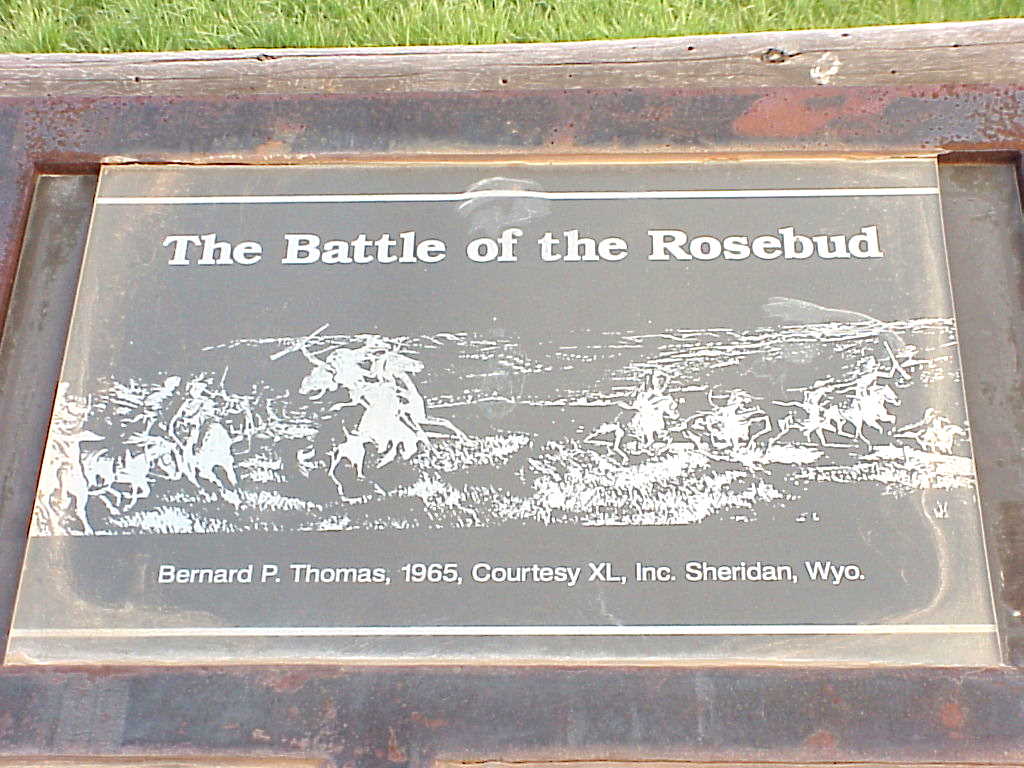
The Rosebud Battlefield is about 50 miles southeast, by road, from the Little Big Horn.
This is the entry from my book for June 17, 1876: "General George Crook was in the field with less than 1,000 men to force the Cheyenne and the Sioux back to the reservation. On this day, Crook’s men encountered Crazy Horse near the Rosebud River in Montana. Rather than risk a frontal attack, or the traditional riding-in-a-ring around the enemy, Crazy Horse and his mounted warriors keep attacking Crook’s flanks. This change in strategy confused the soldiers. During the battle, “Chief Comes In Sight’s horse was shot out from under him in front of the soldiers.” He was rescued by his sister, Buffalo Calf Road Woman. Although the soldiers called this the Battle of the Rosebud, the Indians named it the Battle Where the Girl Saves Her Brother. The Indians won the day. Crook decided to return to his supply camp on Goose Creek until he could be reinforced. First Sergeants Michael A. McGann, Company F, Joseph Robinson, Company D, John Shingle, Troop I ,and trumpeter Elmer Snow, Company M, Third Cavalry, would be awarded the Congressional Medal of Honor for their actions during the fighting. According to army reports, eleven Indians and nine soldiers were killed. Captain G. V. Henry and twenty other soldiers were wounded."

While this battle involved more combatants than the Little Big Horn, it is less well known. The site covers more area, too. It is less well maintained.

Part of a map showing where things happened.
It is about 7am, local time.

This is the first of six pictures. It is looking south from the small park center...

This is the second of six pictures (going from left to right)...looking southwest...

This is the third of six pictures....moving a bit more to the west...

This is the fourth of six pictures ...to the west...

This is the fifth of six pictures ...to the north-northwest...

This is the sixth of six pictures ...the north-northeast...the last picture at the Rosebud Battlefield.

A little southeast of Lame Deer, Montana, I came across these horse walking across BIA Road 4.

This is the tribal headquarters for the Northern Cheyenne Indian reservation in Lame Deer, Montana.

This is in Lame Deer.
They now have a copy of my book.

This is in Busby, Montana.

This is the monument for Chief Two Moons.
Some say he is buried here.

The fencing made it very hard to get a good picture. The site has been vandalized many times in the past. "Here lie the remains of Two Moons, Chief of the Cheyenne Indians who led his men against General Custer in the Battle of Little Big Horn June 25, 1876."

The marker at the front gate...

This is the northern section of the Little Big Horn Battlefield,
looking southwest as seen from Highway 212. The white obelisk is the Custer monument. The low beige structure on the far right in the Indian monument. It was dedicated on June 25, 2003.

A continuation of the picture above looking a bit more to the south. Each of the small white dots is a marker for where a soldier fell.

Picture three of this series (going right to left), looking almost due south.

Curly's grave. He was a Crow scout who accompanied Custer. Some say he was the only true survivor of the battle who fought with (not against) Custer. Others say Curly was the last surviving person on the Army's side to see Custer alive. Others say he left the area before the fighting started. In any case, he became one of the most photographed Indians of his era.

Goes Ahead, see his picture below.


Custer's scouts at site of Custer's death.
L to R: Goes Ahead, Harry Moccasin, Curley, and White-Man-Runs-Him. The above photo has been attributed to various photographers and has been dated as 1890, 1906, and 1913.
Credit: wyomingtalesandtrails.com.


No, he did not die here.

This marker is for some of the soldiers who died fighting the Nez Perce at Bear Mountain, Montana. I have pictures of the battlefield on Page W.

A joint grave for some soldiers from the 5th U.S. Infantry .


The Captain Fetterman from Fort Phil Kearny.

Yes, human remains were found as recently as 1989, 113 years after the battle.

This is the Fort C.F. Smith Memorial for the Hay Field Fight.
This is the entry from my book for August 1, 1867: "After continued incursions into Indian lands, Indians wanted to teach the whites a lesson along the Bozeman Trail. After fasting and other ceremonies, the Indians decided to attack one of the forts along the trail. But no agreement could be reached as to which fort to attack. The Cheyenne decided to attack Fort C. F. Smith in southern Montana (near modern Bighorn Lake). Thirty soldiers and civilians were working in a field of hay a few miles from the fort when a little over 500 Cheyenne warriors come across the group. A frontal attack was repulsed at great loss to the Cheyenne because the soldiers had repeating rifles. The Indians then set fire to the hay. The soldiers were inside a log-walled enclosure when they observed a wall of flames forty feet high approaching them. Luck was on the soldiers’ side, though. Just before the fire reached the soldiers, it died out. Taking this as an omen, the Cheyenne gave up the attack. According to army records, one officer (Lieutenant Sigismund Sternberg), one enlisted man, one civilian, and eight Indians were killed. Thirty Indians were wounded in the fighting."
Ranger Hill (Cheyenne) gave a introductory speech before the short films at the Visitor's Center. His grandfather, who is still alive, knew people who participated in the battle. The park has taken on a more equilateral look at the fighting. It is no longer the scene of a massacre. Now, it is treated as two different groups who were both fighting for their country. In the over 125 years since the battle, the first major monument to the Indian participants is finally being created. On the site mentioned above, you can see a marker for one Indian who was killed in the battle, and the major monument for the Indian participants. It will be officially dedicated on June 26th. Oddly enough, only part of the park is government land. A large section in the middle is privately owned. You can still drive through the area. The markers you see on the battlefield are for where the bodies of the soldiers were found. Ranger Hill said that people have counted over 250 markers. This is strange because less than 230 soldiers were killed. The story goes that the markers, which are very heavy, were hauled many miles by wagon to the site. When they discovered that they had too many markers, no one wanted to haul them back. So, they just distributed them over the battlefield. Ranger Hill's father was in the US army. He said the army still works like that.
(written May 22, 2003)
