This article was written in 1993 for the "California Highway Patrolman" magazine. I ran computers in Mission Control in Houston during Apollo 16 & 17, and the Skylab project.

Wally Schirra and me about the time this was written. He hurt his collarbone when he fell off a horse. He said, "I prefer water landings!"
"And Then We Flew To The Moon"
A Look Back, and Into the Future with Walter Schirra, Astronaut
by Phil Konstantin
When everything has been written about the twentieth century, what will be considered
its most significant event? According to writer Blaine Baggett, it may well be the fact
that ours was the time when humanity escaped the bounds of earth.
Some people believe the "space age" started when Robert Goddard launched the world's
first liquid-fueled rocket in 1926. Purists may favor 1898, when Konstantin (interesting
name!) Tsiolkovski, the "father of astronautics," worked out the theory of rocket
propulsion. Other people opt for the launch of Sputnik 1, the first artificial satellite
in 1957. But, in many minds, the beginning of the space age was marked by the flight
of the first man in space, Yuri Gagarin on April 12, 1961.
The first true rockets were designed and flown by the Germans during World War Two
under the leadership of Werner Von Braun. When Von Braun came to America, he, and
his team, continued to develop rockets. The Air Force began development of the Thor,
Atlas and Titan missiles at about the same time. Von Braun's team eventually developed
the Redstone, Juno and Saturn.
The United States entered the "manned" space age in the 1960s with a certain amount
of drama and flair with seven men dubbed the "Original Seven" astronauts. These seven
men were: Alan Shepard, "Gus" Grissom, John Glenn, Scott Carpenter, Gordon Cooper,
Donald Slayton and Walter M. Schirra, Jr.

The Original 7 astronauts. Schirra is on the
bottom left. NASA photo.
Schirra, born in 1923 and a frequent resident of San Diego, holds an unique place in
the American space program. He was the only person to fly in all three of America's
first manned projects: Mercury, Gemini and Apollo. Schirra's parents were also
interested in flying. At one point, they were barnstormers. His father would fly,
while his mother would walk on the wings. Schirra jokes that his mother only gave
up wing walking when she found out she was "carrying him in the hanger" (pregnant).
Schirra proudly claims that he was flying even before he was born.
Project Mercury was a one-person spacecraft which used either the Redstone or the
Atlas rocket. This program lifted off on May 5, 1961 with Alan Sheppard's first
flight. It ended with Gordon Cooper's twenty-two orbit flight on May 15, 1963. Project
Gemini featured a two-person spacecraft and the Titan rocket. The Titan, which was
originally built in San Diego, is still used today to launch satellites. Gemini
lasted from April 8, 1964 to November 11, 1966. It had two unmanned flights and ten
manned excursions. The Apollo program launches began on February 26, 1966 and ended
with the last moon flight on December 19, 1972. There were six unmanned and eleven manned
Apollo missions. Apollo used a three-person "capsule" and the Saturn booster.
Most people are familiar with the basic background of the American space program through
the original television and newspaper reports, books, documentaries and movies, such
as "The Right Stuff." Schirra's personal favorite chronicle of the Mercury program was
a four-part series produced for PBS, called "Spaceflight." Not everything which is
"common knowledge" about the space program is true. Recently, I had the chance to
talk with Schirra about some of his fonder memories, and about how he feels about
the future in space.
The selection process for the first group of astronauts included the following criteria.
Each candidate had to be:
1. Between 25 and 40 years old
2. Less than 5'11" (I once met the man who set this limit.
He was 6'1" and had to eliminate himself)
3. Excellent physical condition
4. No less than a bachelor's degree or equivalent
(preferably in engineering)
5. Be a graduate of test pilot school
6. 1500 hours of total flying time, or more
7. A qualified jet pilot.
According to Michael Collins, a member of the Apollo 11 crew, this limited the selection
to approximately 110 qualified candidates.
Almost all of the men who qualified (being a man was an unwritten requirement) were
"invited" to participate in the selection process. However, Schirra cleared up some
misconceptions about all of the astronauts "volunteering" for the initial astronaut
selection process. "I did not volunteer, we (all of the qualified pilots) were ordered
to the Pentagon for this great briefing on getting into a capsule on top of a rocket
and being successor to a monkey or a chimpanzee." Chuck Yeager (the first person to
break the sound barrier) did not put it that tactfully. He said, "I wouldn't want to
have to sweep off monkey shit before I sat down in that capsule."
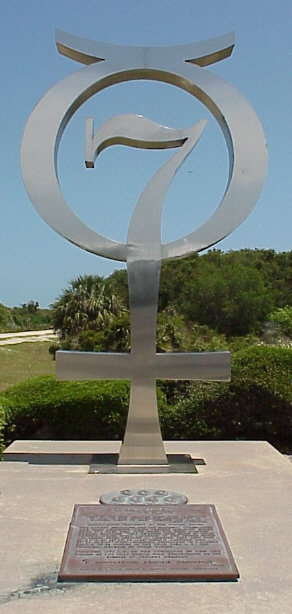
The Original 7 monument at Cape Kennedy.
My photo.
At that initial briefing, the pilots were told they were candidates for a new program
to put a man in space. The program was run by a relatively new government agency, the
National Aeronautics and Space Administration (NASA). Many men turned down this
opportunity. After careful consideration, Schirra reluctantly did take this chance to
go higher, farther and faster ("every fighter pilot's goal"), and he did volunteer
for the project. Schirra had some misgivings about leaving his career as a Navy test
pilot. According to Schirra, of all the candidates, only John Glenn had any inside
information on what the program was really about.

Wally's NASA portrait (October 1962).
The original astronauts had to fight to become an active part of the controls of the
Mercury capsule. This crusade led to the eventual success of many of the later flights.
"Gordo" Cooper lost almost all of his automatic controls during the last Mercury
mission. He made a completely manual landing. "We had to fight for precise controls,"
Schirra added about the Gemini and Apollo missions. Schirra once remarked, unlike a
jet, the controls of a spacecraft took a very delicate touch. He said, "it should have
been called the 'light stuff,' instead of the 'right stuff'!"
While the space program was replete with technical terms and jargon (my own contribution
while working at NASA was to describe sleeping as "an inner eyelid terrain study"),
the astronauts did have a few words they did not like. Rocket was changed to booster,
"blast off" was changed to "liftoff," and capsule became spacecraft. When Schirra did
a television commercial for Actifed (a cold remedy), he joked that he used to fly
capsules, and now he was pitching them. The Gemini 6 liftoff experience related below
was a good example for this choice of words. Schirra told me he was at the Cape during
the liftoff of an unmanned Atlas rocket (the same model rocket he flew on his Mercury
mission) just after his Gemini 6 flight. The control room crew invited him to watch the
"blast off." Sure enough, it did blast off. It exploded in a ball of flames about 100
feet above the launch pad. Fortunately, it was am unmanned flight. Talk about a
confidence builder!
During the initial training periods of the Mercury program, psychologists attempted to
determine what were the best personal and psychological attributes for astronauts to
possess. Most of the Mercury program candidates felt the doctors were making their
tests up as they went. In reality, they probably were, because this was an entirely
new field of study. The candidates were poked, prodded and were forced to submit to
many humiliating examinations. There was plenty of resentment, and pranks were often
directed at the doctors who seemed to make much ado about nothing. Due to his frequent
pranks, Pete Conrad (you make recall another article I wrote which discussed his
peanut butter cookie addiction) was described as unlikely to be able to work with
others in a confined space. According to Schirra, this was why Conrad was not one of
the seven original astronauts. Pete would later fly successfully (although
tongue-in-cheek, at times) on Gemini, Apollo and Skylab missions of long durations.
Conrad once confounded the doctors by insisting that a completely blank Rorschach test
card (the famous ink blot tests) was being held upside down. Schirra said, "in those
early days, we felt we were well patients being looked at by sick doctors."
The sights from space are quite striking. Almost all of the astronauts, from the
Mercury program through to the shuttle, have rhapsed poetic about the beauty of the
Earth and of sunrises as seem from space. However, during those early missions,
Schirra said that the most beautiful sight was when the astronauts saw their
parachutes deploy and they knew they were safely back to Earth. "Without that sight,
it was a lousy mission," mused Schirra. Although Gus Grissom did almost drown during
his "splashdown."
Schirra's Mercury flight (Sigma 7) was the quintessential "textbook" flight. He was
able to manually correct the positioning of the spacecraft. Schirra also discovered
that the "fireflies" seen by John Glenn and Alan Shepard were actually frozen water
coming from the heat exchange unit. Schirra made six orbits before he began his
re-entry. Sigma 7 landed withing 4.5 miles of its recovery ship, Kearsarge. With a
smile, Schirra says that he actually would have landed on the ship if "they" had
been in the correct location.

The liftoff of the Sigma 7. NASA photo.
Schirra also proved that Gus Grissom could not have accidentally activated the
controls which blasted open the hatch of his spacecraft. Grissom had been chided
by many for blowing the hatch prematurely. Grissom maintained that the hatch
malfunctioned. With the hatch off, Grissom's "capsule" filled with water and sank.
Grissom was barely able to stay afloat as his suit filled with water. After the
Sigma 7 had been secured, Schirra purposely activated the controls to blast the
hatch. Schirra had to hit the controls so hard that he injured his hand. Grissom
didn't even have a bruise, proving he did not activate the system. Grissom was
very grateful for Schirra's proof!

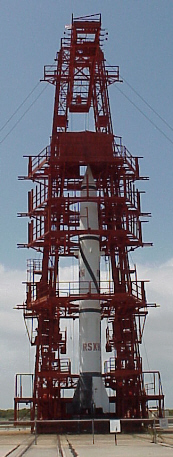
The Mercury launch pad with a lifesize rocket
replica. My photo
Schirra describes the Gemini capsule as a two-seater Mercury, much like the front
of a Volkswagen bug. "There wasn't much room to do your tasks. In fact, you could
not straighten your legs." This may have led to more of the wobbly legs on the
recovery ships than any prolonged exposure to weightlessness. However, Schirra
like the Gemini spacecraft best of the three types he "flew." "It's like a two-seater
fighter. The first sixteen astronauts were fighter pilots and we feel very acclimated
to a small cockpit," he said without any hesitation.
The original plan for the Gemini 6 mission was for it to dock with an unmanned
spacecraft that would be launched into orbit just before they took off. But, while
Schirra and Tom Stafford (who would later fly on Gemini 9, Apollo 10, and on the
Apollo-Soyuz flight) sat in the Gemini capsule waiting to go, the target craft
malfunctioned. So, the liftoff was scrubbed. It was decided to combine the Gemini 6
and 7 flights.

Tom Stafford & Walter Schirra. NASA photo.
On their second attempt at a liftoff, Schirra and Stafford faced, perhaps, the most
dangerous liftoff situations short of the Challenger disaster. One and a half seconds
after the ignition of their Titan booster, it shut down. Based on his training,
Schirra gambled correctly that the 150 tons of fuel in the rocket was not going
to explode. He did not activate the escape rocket. The liftoff stalled because
someone had failed to remove a dust cap from the fuel line. Three days later, on
their third attempt, the Gemini 6 mission finally lifted off and made it to orbit
to rendezvous with Gemini 7. This was the first rendezvous in history! Schirra's
Gemini 6 flight was supposed to go into space before Gemini 7. Due to all of the
delays, Gemini 7 made it there first (note the dates on the Gemini missions photo
below).
 |
 |
| Gemini liftoff. NASA photo. |
Gemini flights sign at the Kennedy Space Center. My photo. |
When President John Kennedy made his famous speech in May 1961 about sending a man
to the Moon and back before the end of the decade, Schirra related that the astronauts
were very happy to hear the words "and back."
Schirra flew on the Apollo 7 mission with Walter Cunningham and Donn Eisele. None of
these three would ever fly another space mission. "Wally, Walt and Whats-his-name's"
October 1968 flight lasted for eleven days, and proved to be very successful. This
first manned Apollo mission was to take the command and service modules into space
and to test them. This equipment would later be used to land on the moon.

Astronauts Cunningham, Schirra and Eisele.
NASA photo.
At 46 years of age, and shortly after this flight, Schirra left the space program
for a variety of reasons. Schirra said he wanted to quit while he was ahead. He was
also concerned about the move away from crew concerns and "pilot involvement" in
program developments, to the shift of attention to strictly technical advancements.
He felt it was time to move on. He had changed, as well as the space program.
Schirra has some strong opinions on the former Soviet Union's space programs. The
competition with the cosmonauts of the Soviet Union was one of the driving forces
of the American space program. Schirra feels the U.S. passed the former U.S.S.R.
sometime during the middle of the Gemini program. During the Apollo 11 lunar landing,
the Soviets had an unmanned craft circling the moon. Schirra said the Soviets were
prepared to say that sending men to the Moon was inappropriate, had the Apollo
mission failed. Ironically, the Soviet mission crashed.
Commenting on the comparative worth, abilities and accomplishments of the Soviet
and American programs, Schirra felt the American program was often incorrectly
lables as inferior. "The Skylab was larger than what the Soviets have in Space
today. The Russians are reknown for making bigger boosters. The Saturn V booster
was half again larger than anything the Russians ever made. Yet, we've conceded
that away, or least the press corp has. The Soviets built one shuttle and that
barely made it through one orbit. We've lost the enthusiasm that we had. I blame
it somewhat on politicians who have two, four and six year mentalities. Now we
are saying that the Soviets are such great space technicians and that we should
use their equipment. I was surprised when I visited Star City (the Soviet equivalent
to Cape Canaveral) in the Soviet Union just before the big governmental changes
in 1991. I was sitting next to Aleksei Leonov, the man that did the first space
walk, and I sneezed. He said 'God bless you' and I asked him if he could say that.
He said, 'soon, I can say that.'" Schirra quipped. He saw the Soviet people as
hard workers, but their system was riddled with problems.
Schirra characterized the early Soviet system as a cannonball design. The cosmonauts
were just ballast until their craft landed. Whereas, the American astronauts fought
to avoid this approach from the beginning.
According to Schirra, the demise of the American space program came about when
American politicians lost interest. "first the politicians lost interest, then
the advertizers lost interest. I was broadcasting with Walter Cronkite, and we
couldn't get financial airtime to put on the Apollo 15 flight that had that great
lunar rover," Schirra said. Schirra felt the media then lost interest. "The media
thought that the public lost interest, but that was not the case. The public has
always been interested in the space program."
"As you look back on the Apollo mission, as I see it, I almost would call it a
stunt. It's a horrible thing to have to say. There was nothing left when we got
done with the Apollo program but a few pounds of lunar material," Schirra said.
"So why did we do that? Well, we were competing. We were trying to show the
world that we were the technological leader. And we are. Then we mired ourselves
in the Skylab mission, losing sight of the fact that we had no way to get up
there if it came down. And, of course, it did come down," he added. Skylab burned
up in July 1979 after its orbit decayed and it was finally dragged back down into
the main part of the Earth's atmosphere. A young man from Australia actually won
a $10,000 prize from a San Francisco newspaper by being the first person to give
the newspaper a piece of Skylab that had survived the return to Earth (not much
of it did!).
Currently, the United States has plans for a permanently staffed space station
called "Freedom." There are also plans on the drawing boards for a trip to Mars,
possible in conjunction with the former Soviet Union.
When asked about the future of the space program, Schirra said, "I think we need
to have a committment to being in space, such as the space station Freedom or
something smaller." The initial plans for Freedom were too palatial for Schirra.
He felt it was a "Taj Mahal in space that wanted to do everything for everyone."
"This project should stand in line with all of the other priorities," he added.
The shuttle is also too expensive to be a viable part of a working space program
to Schirra's way of thinking. "Paying off the entire project, including research,
manufacturing, development and operations, it comes out to roughly one billion
dollars per shuttle flight. We have to face reality, we cannot afford all of these
toys." Schirra is interested in some of the newer proposals for "booster-type"
vehicles that will take off and land as one vehicle.
Schirra is also interested in doing research on "Spaceship Earth." We have the
equipment to look at this planet in many different ways and disciplines and to
correlate all of the data into one system, he said.
The by-products of the space program have been very profitable and impressed
Schirra. "It's not just Teflon frying pans and Tang!," he joked. The demand for
miniaturization for space program applications led to many consumer products.
Schirra cited hand held computers, miniature television screens and cameras,
video tape systems. composite materials, global positioning systems (the CHP
has tested these in patrol cars) and medical sensors are just some of the
spinoffs of the space program.
Each of these technological advances were directly tied to some aspect of the
space program. "Pocket computers" were developed in the late 1960s based on a
NASA requirement for smaller computer systems. NASA needed to know what physiological
changes the astronauts were experiencing. This created a need for small devices
which could detect vital medical information. This information then had to be
relayed back to Earth to te medical flight crews. Almost all remote medical sensors
which exist today had progenitors which were created for the space program. These
systems are now used in all modern hospitals.
Recently, the CHP has tested several devices which would let dispatch centers know
exactly where each patrol vehicle is located, in case of an emergency. One of these
systems uses several orbiting satellites to "triangulate" the location of small
sensing devices which has been placed in a patrol car. This type of information
could be used to track a patrol car as it pursues a stolen vehicle through unfamiliar
territory, such as a winding mountain roads or unpaved desert areas. It could also
be used to find a patrol car which may have crashed and left the officer
unconscious.
Many modern materials were developed because of space program needs. Carbon graphite,
ceramics and many special metal alloys were required for various parts of the
spacecraft which needed to be light in weight, flexible, durable, and able to
withstand extremes in temperature. In the consumer world, golf clubs and tennis
rackets use carbon graphite as a basic building block. Titanium and "cro-mo"
alloys are used to make modern bicycle frames lighter and more durable than regular
steel. Modern ceramics are being used in many fields from electronics to
insulation.
Each of these products, and many more, found their conceptual genesis in the
space program. Schirra said, "It's probably the one time in our history of the
world where technology made monstrous strides without penalty of war."
When considering the prospects of a major push in space exploration, Schirra
expressed some doubts as to the motivation of the American private sector. Schirra
surmised the Apollo program was a competition, it was a race of national pride,
and that condition does not exist today.
Would he advocate a flight to Mars? Schirra emphatically stated, "I left this
planet three times and I found no place else to go, so I stayed. I am interested
in a concept called 'Project Earth.' We should eventually explore Mars and the
Moon, but we need to worry about what we have here now. Even the scale of proposed
orbital habitats is beyond our current economic abilities. There are a lot of good
'gee whiz' ideas out there, but there is still a lot of room here on Earth. I was
once a part of a commission to study the commercial applications of space based
operations. We concluded there is no real commercial venture in space that will
pay off, meaning giving you return on investments, with the possible exception of
communication satellites."
Schirra summarized that he was very proud of his association with NASA. "I just
hope that we can recapture the same kind of enthusiasm again that we had then. I
know it is there, it is within the American spirit."
Schirra enjoys his free time and he enjoys an active life, spending much of it
outdoors in southern California. Schirra recently broke his collarbone when he
was thrown from a horse near Solvang, California. His astronaut training taught
him to choose a water landing over a ground landing most times. "I'll choose a
water landing over a horse trail, any time," he said.
Schirra has many funny stories to tell which relate to his experiences in space
and how the world received his as a hero and a celebrity. Schirra claims that
only Pete Conrad surpassed him as a mischief-maker at NASA, a "smartass-tronaut"
is how he puts it. One of his milder practical jokes came during the rendezvous
of the Gemini 6 and 7 spacecraft. Schirra and Stafford on Gemini 6 were both Naval
Academy graduates. Aboard Gemini 7 was James Lovell, who would also fly on Gemini
12, Apollo 8 (the first flight to circle the Moon) and the ill-fated Apollo 13.
Lovell was also a Naval Academy alumni (they call themselves "ring-knockers").
The other member of Gemini 7 was Frank Borman. Borman was a graduate of West Point.
He would later fly on the Apollo 8 mission and eventually become president of
Eastern Airlines. As the three Navy men and the one Army man prepared to make
the historic first spacecraft docking maneuver, Schirra planed a little diversion.
He placed a sign in his window facing Gemini 7. It read, "Beat Army!"
Schirra once owned a home on Kauai in Hawaii. He returned to Kauai several years
after he sold the house. He wandered into a real estate office just to see what
the current prices were in his old neighborhood. A real estate agent was showing
a map of the area to another customer when she pointed to a certain spot and said
that Schirra used to live in that area. Schirra was surprised because his home
had actually been several miles away in a less "pricey" part of town. When Schirra
told the agent of her mistake, she told him that she had lived in the area for
years, and she knew where the famous astronaut had lived. Schirra insisted that,
not withstanding her longevity in the area, Schirra had lived in the other area.
Finally, the exasperated salesperson asked him what made him so sure that Schirra
had lived in the other area. Schirra said, "ma'am, I used to be Wally Schirra!"
During our conversation, Schirra confirmed my own personal favorite story about him.
It happened just after his first space flight, when he was regarded as a true
national hero. Some of the Mercury psychologists were concerned about how the
astronauts would recover from the adulation they would face after a successful
flight. After the end of his Mercury "Sigma 7" flight, Schirra was feted by all
of the available dignitaries in Houston, and anyone else that could sneak in (I
was too young, then). After a long night of speeches and awards and pats on the
back, the party tranferred to the Schirra home. Finally, near 1:30 in the morning,
the party broke up. As Walter was preparing to go to bed, his wife Jo (they have
been married now for almost 47 years), reminded him to take out the garbage before
he went to sleep. "That's the way to get back to Earth in a hurry," he said.

Wally in a parade through Houston.
NASA photo.
Click here to return to my Kennedy Space Center page
Click ere to return to my Main page
About My Book
Below is a picture of the cover of my book
"This Day in North American Indian History"
IT IS NOW AVAIABLE.
Click on the cover to order a copy
Click here to order a copy of my book
in the USA.
or
In the U.K.
or
In Germany
or
In France
or
In Canada
Click on the drop down menu:
or
Click on the image below to go to......
My Website's Home Page |
Links: (8,700 and counting) |
Tribal Names |
Indian Moons |
Personal Photos |
My Biography |
Sleepy Driver |
The Space Program |
Ancient Ruins in Central America |
Maya Ruins in Mexico |
Whales |
Awards & Webrings |
Cherokee Holiday 2001 |
Cherokee Enrollment |
My Newsletters |
My Store |
California Highway Patrol |
Indian Era Forts |
Articles I Wrote |
Northwestern USA Indian Country |
American Indian Museum in D.C. 2004 |
Movie & Book Reviews |
KUSI TV, my other job |
Mesa Verde and Utah in 2006 |
My Mortgage Loan Company |
2006 SDSU Powwow |
Beach Photos |