June 2010 Newsletter from
"This Day in North American Indian History"
by Phil Konstantin
Copyright © © Phil Konstantin (1996-2013)
Click Here To Return To The Previous Website
.
.
.
.
.
.
.
.
.
================================================
Phil Konstantin's June 2010 Newsletter - Part 1
================================================

Greetings,

I have spent the last month, and part of April, going through my
links pages. Keeping them up-to-date is very difficult. One minor
change on a big website could mean that I have to change lots of
links. Since there are about 9,000 links, it is a massive
undertaking to update it. That's why it has been so long since
I have checked all of the links. So, now you can go through the
links pages with a "reasonable" expectation that most of the
links will work. As usual, please let me know if you find a link
which does not work.


Tomorrow will be my last day at KUSI-TV in San Diego. After five
years, I am going to leave. I have had a great time while working at
KUSI. My co-workers are all good people. I've had a chance to meet lots
of other folks, too.    Starting June 7th, I will be working
as the helicopter reporter at KGTV (Ch.10). I was on KGTV from
1996 to 2005 which I was a CHP officer. I love to fly, so it
should be a nice change. I'll be on both the morning and afternoon
news programs.


I have added more photos of my grand-daughter Jazlyn to the page
below. You can view them you are so inclined.

http://americanindian.net/Rose/index.html


I'll have a Part 2 to the newsletter soon...


Phil Konstantin

====================================
X+X+X+X+X+X+X+X+X+X+X+X+X+X+X+X+X+X+
====================================

Here are some random historical events for June:

I have added some internet links for each of the events below. You
can visit those sites to learn a little bit more about each of these
happenings.


June 1, 1934: A legal definition of "Indian land" is made by the United
States government.


June 2, 1752: Diego Ortiz Parrilla, Lieutenant Colonel of the Royal
Armies, Proprietary Captain of the Dragoons of Veracruz, Governor and
Captain-General of the Provinces of Sinaloa and Sonora in the Kingdom of
New Andalucia declares the estalishment of a permanent Spanish community
at what would become modern Tubac, Arizona. This would be the first
significant Spanish settlement in Arizona.

Read more about him at:
http://www.tshaonline.org/handbook/online/articles/OO/for12.html


June 3, 1823: Yesterday a trapper is killed in a Arikara village. The
Arikara warriors attack Jedediah Smith and his forty men who are camped
on the nearby river. There are also ninety men stationed on boats in the
river. Fearing for their lives, the men in the boats refuse to come help
Smith’s men. Fifteen men are killed and almost as many are wounded in
the fighting before they can swim out to the boats and flee.

Read more about it here:
http://historytogo.utah.gov/people/jedediahssmith.html


June 4, 1696: A second Pueblo revolt takes place in modern New Mexico.
Participating tribes were the Cochiti, Picuris, Santa Fe, Santo Domingo,
Tano, Taos and Tewa. Twenty-one settlers and soldiers, and five
missionaries are killed in the fighting. The revolt would not be long
lived.

Read more about it here:
http://books.google.com/books?id=PS-y_9q9gCsC&printsec=frontcover&dq=%22Pueb
lo+revolt%22+1696&source=bl&ots=mWdhL04IPN&sig=tY3bf-eozTbwoF7P96MS0hqQdmU&h
l=en&ei=ym_4S7P5MYPUMvjV_I4F&sa=X&oi=book_result&ct=result&resnum=10&ved=0CF
MQ6AEwCQ#v=onepage&q&f=false


June 5, 1836: Of the 407 "friendly" Seminoles who left Tampa Bay on
April 11, 1836, only 320 arrive in their new lands in the Indian
Territory (present day Oklahoma). Eighty-seven of the Seminoles die
during the rigorous trip.

Read more about it here:
http://www.seminolenation-indianterritory.org/


June 6, 1962: The Fort Apache Scout is first published.

Read more about them here:
http://www.wmat.nsn.us/


June 7, 1494: The "new world" is divided between Spain and Portugal by
the Catholic church.

Read more about it here:
http://www.reformation.org/treaty-of-tordesillas.html


June 8, 1758: General Jeffrey Amherst is leading a force of more than
10,000 soldiers on a fleet of almost fifty British ships. They land and
attack the French fort at Louisbourg, Nova Scotia. The French forces are
led by Chevier de Drucour. He has 3,100 soldiers, 1,000 Canadians and
500 Indians at his disposal. The French also have a fleet in port. The
fighting continues until July 26th. The British are victorious. Fearing
they will be executed, many of the Indians will flee because the British
offer terms of surrender only to the French troops.

Read more about it here:
http://en.wikipedia.org/wiki/Siege_of_Louisbourg_%281758%29


June 9, 1870: Ely Parker (Donehogawa) commissioner of Indian Affairs
invites Red Cloud, and several other Sioux to visit him, and the Great
Father, in Washington. Red Cloud meets President Ulysses Grant. Red
Cloud tells Grant the Sioux do not want a reservation on the Missouri
River. Red Cloud also talks about some of the promises made in the
treaty which were not actually included. They have a cordial meeting,
but Grant knows the difference between the items promised, and the items
actually in the treaty are grounds for contention in the future. He
suggests the Indians be read the treaty in its entirety soon.

Read more about him here:
http://www.pbs.org/warrior/noflash/index.html


June 10, 1909: The U.S. Supreme Court confirms and approves Guion
Miller's new tribal rolls of the Eastern Cherokees who are entitled to
share in the distribution of a $1,000,000 fund the Court established in
1906.

Read more about it here:
http://www.footnote.com/page/93189061_eastern_cherokee_applications_of_the/


June 11, 1848: Alexander Barclay establishes a trading post and fort and
the juncture of the Sapello and Mora Rivers in northern New Mexico. The
Santa Fe Trail runs past the post. It will eventually become a part of
the later constructed Fort Union, one of the largest military outposts
in the American Southwest.

Read more about it here:
http://www.nps.gov/archive/foun/adhi/adhi1.htm


June 12, 1755: Massachusetts posts its "Scalp bounty."

Read more about it here:
http://www.mainememory.net/pdf_files/FK-MMN-3-2.pdf


June 13, 1660: Wamsetta, a Wampanoag, and his younger brother, Metacomet
(various spellings), have requested "English" names from the Plymouth
court. Their names are officially changed to Alexander and Philip
Pokanoket. Philip is eventually called "King Philip."

Read more about it here:
http://www.prenticenet.com/news/2007/indian_prentices.htm


June 14, 1867: According to the Constitution of the Coeur d’Alene Tribe
of Idaho, The Coeur d’Alene Reservation is established by Executive
Order.

Read more about it here:
http://thorpe.ou.edu/IRA/coeurcons.html


June 15, 742: According to Maya engravings, King Itzamnaaj B'alam II
(Shield Jaguar) of Yaxchilan, Mexico dies.

Read more about it here:
http://wapedia.mobi/en/Yaxchilan

See my photos here:
http://americanindian.net/mexico17.html


June 16, 1802: A treaty (7 stat. 68) with the Creeks is concluded near
Fort Wilkinson, on the Oconee River, near present day, Milledgeville,
Georgia. New tribal boundary lines are established, which cede lands
along the Oconee and Ocmulgee creeks, and the "Altamaha" tract. The
tribe receives $3000 annually, and some Chiefs get $1000 a year for ten
years. The tribe gets $10,000 now, and $10,000 is set aside to pay
tribal debts to local white traders. The Creeks also receive $5000 for
lands that have been seized. They also get two sets of blacksmith tools,
and trained blacksmiths to use them for three years. The United States
gets the right to establish a garrison on Creek lands. The treaty is
signed by thirty-nine Indians. The Americans are represented by General
James Wilkinson, Benjamin Hawkins and Andrew Pickens.

Read more about it here:
http://www.archive.org/stream/georgiacomprisi02unkngoog/georgiacomprisi02unk
ngoog_djvu.txt


June 17, 1579: Sir Francis Drake lands north of San Francisco, probably
at what is today called Drake's Bay, in California. He reports the
Indians to be "people of a tractable, free and loving nature, without
guile or treachery."

Read more about it here:
http://www.longcamp.com/nav.html

See my photos of Point Reyes here:
http://americanindian.net/scan/California/VariousPlacesinCalifornia/index.ht
ml


June 18, 1934: The Indian Reorganization Act (48 Stat. 984-985) takes
place. Among other things, it is to "permit any Indian to transfer by
will restricted lands of such Indian to his or her heirs or lineal
descendants, and for other purposes. To authorize the sale of individual
Indian lands acquired under the Act of June 18, 1934 and under the Act
of June 26, 1936."

See a copy of the text on this website:
http://www.maquah.net/Kafkaesque/IndianCourt/IRA.htm


June 19, 1541: Hernando de Soto's expedition meets the Casqui Indians
near modern Helena, Arkansas. There has been a drought in the area, and
the padres offer to help. A large cross is erected and the Spaniards
join in prayer. Soon it starts to rain. The Casquis become allies of the
Spanish.

Read more about it here:
http://www.uark.edu/campus-resources/archinfo/parkin_site.pdf


June 20, 1763: As part of Pontiac's rebellion, a force of Senecas,
Ottawas, Wyandots, and Chippewas attack Fort Presque Isle, at present
day Erie, in northwestern Pennsylvania. They have had the fort under
siege since June 15th. The soldiers numbering less than three dozen,
surrender when the fort goes up in flames. All but Ensign John Christie
and two others escape. The rest are killed.

Read more about it here:
http://en.wikipedia.org/wiki/Fort_Presque_Isle


June 21, 1856: Non-hostile Indians along the lower Rogue River, and at
Fort Orford, in southwestern Oregon, are put on a boat to be moved to a
new reservation between the Pacific Ocean, and the Wallamet River. It is
called the Grande Ronde Reservation.

Read more about it here:
http://www.historylink.org/index.cfm?DisplayPage=pf_output.cfm&file_id=8146


June 22, 1839: Elias Boudinot, first editor of the Cherokee Phoenix,
Chief Major Ridge (Kahnungdaclageh) and his son, John Ridge
(Skahtlelohskee) are members of the Cherokee "Treaty Party." They have
generated many enemies by their stand agreeing to the removal of the
Cherokees from their lands east of the Mississippi River. They signed
the peace treaty which gave away Cherokee lands east of the Mississippi
River. They moved to Indian Territory (present day Oklahoma) with the
rest of the Cherokee Nation. Early this morning, John Ridge is dragged
from his bed, and stabbed to death. Chief Major Ridge is shot and killed
at 10:00 am in another part of the reservation. Later that day, Elias
Boudinot is stabbed and hacked to death. These murders are committed by
Cherokees for what they feel is their treasonous betrayal of the nation.
A Cherokee law, which Chief Ridge helped to make, gives the death
penalty to any Cherokee who sells or gives away Cherokee lands without
the majority of the tribe's permission. These deaths are considered the
execution of that law. Chief Stand Watie, brother to Elias, and nephew
to Major Ridge, manages to avoid the warriors who planned to kill him.

Read more about it here:
http://en.wikipedia.org/wiki/Elias_Boudinot_%28Cherokee%29


June 23, 1865: General Stand Watie, and his Cherokee Confederate
sympathizers, surrender. Stand Watie is the last Confederate General to
officially surrender.

Read more about it here:
http://www.arts.ok.gov/capitolart/permart/paintings/parker/surrender.html


June 24, 1763: As part of Pontiac's rebellion, a group of Delaware
surround Fort Pitt, in present day Pittsburgh, Pennsylvania. The
commander, Captain Simeon Ecuyer, has 338 soldiers in the fort, and he
will not surrender. Not having enough warriors to attack the fort, the
Delaware leave the fort with a few blankets as a present. Unknown to the
Indians, the blankets came from a infirmary treating smallpox. The
Delaware are the first to be affected by this form of biological warfare
during the rebellion. Some sources says this happens on July 24th.

Read more about it here:
http://en.wikipedia.org/wiki/Siege_of_Fort_Pitt


June 25, 1876: At the Battle of the Little Big Horn, Colonel George
Custer is commanding Troops C,E,F,I, and L; Major Marcus Reno has troops
A,G, and M. Captain Frederick Benteen leads Troops H,D, and K. Captain
Thomas McDougall guards the supply wagons with Troop B. It is a
significant defeat for the U. S. Army. Army reports list thirteen
officers, 189 enlisted men, and four civilians are killed in Custer’s
command. Reno’s troops split from Custer’s. According to army documents,
Lt. Donald McIntosh, Lt. B.H. Hodgson, forty-six soldiers, and one
civilian are killed. Captain Benteen, Lt. C.A. Varnum and forty-four
soldiers are wounded in the fighting which lasts through tomorrow. Army
reports do not list how many Indians were killed or wounded in this
defeat for the army. The following soldiers receive Medals of Honor for
actions during this battle today and tomorrow: Private Neil Bancroft,
Company A; Private Abram B. Brant, Co. D; Private Thomas J. Callen, Co.
B; Sergeant Benjamin C. Criswell, Co. B; Corporal Charles Cunningham,
Co. B; Private Frederick Deetline, Co. D; Sergeant George Geiger, Co. H;
Private Theodore Goldin, Troop G; Private David W. Harris, Co. A;
Private William M. Harris, Co. D; Private Henry Holden, Co. D; Sergeant
Rufus D. Hutchinson, Co. B; Blacksmith Henry Mechlin, Co. H; Sergeant
Thomas Murray, Co. B; Private James Pym, Co. B; Sergeant Stanislaus Roy,
Co. A; Private George Scott, Co. D; Private Thomas Stivers, Co. D;
Private Peter Thompson, Co. C; Private Frank Tolan, Co. D; Saddler Otto
Voit, Co. H; Sergeant Charles Welch, Co. D; Private Charles Windolph,
Co. H.

Read more about it here:
http://rightwingnuthouse.com/archives/2005/06/25/the-battle-of-greasy-grass-
creek/

http://query.nytimes.com/mem/archive-free/pdf?_r=1&res=9500E4D71431EF34BC4D5
2DFB566838C669FDE

http://www.friendslittlebighorn.com/The-battle.htm
http://buffalopost.net/?cat=339
http://www.pbs.org/weta/thewest/program/episodes/six/goodday.htm
http://home.earthlink.net/~kgann/Custernotes.html
http://books.google.com/books?id=DSRhE9bB1M4C&pg=PA133&lpg=PA133&dq=battle+o
f+the+greasy+grass&source=bl&ots=7It7JBkGaB&sig=hf7e0xzk-XomYy0-I5H-5q0WoTY&
hl=en&ei=_oD4S8GaK5iQMpeqmYQI&sa=X&oi=book_result&ct=result&resnum=4&ved=0CC
YQ6AEwAzgK#v=onepage&q=battle%20of%20the%20greasy%20grass&f=false


See my photos of the area here:
http://americanindian.net/2003k.html


June 26, 1874: The Comanches under Quanah Parker decide to punish the
white hunters for killing their buffalo herds and taking their grazing
lands. Joined by Kiowa, Cheyenne and Arapahos, they set out for the
trading post called Adobe Walls in the panhandle of Texas. Medicine man
Isatai of the Comanche promises the bullets of the white men will not
harm them. A buffalo hunter named William "Billy" Dixon sees the Indians
approaching, and he is able to fire a warning shot before the attack.
The Indians charge the trading post. There are twenty-eight men, and one
woman, in Adobe Walls, and the buffalo hunters there have very accurate,
long-range rifles with telescopic sights. Dixon is reported to have
knocked an Indian off his horse from 1538 yards away with one of these
rifles. The adobe walls provide very good cover for them. Slightly more
than a dozen Indians are killed in the fight, and Isatai is humiliated.
The Indians give up the fight as hopeless, and they leave. Some sources
report this fight happening on June 27, 1874 and lasting until July 1st.

Read more about it here:
http://en.wikipedia.org/wiki/Second_Battle_of_Adobe_Walls

See some of my photos of the area here:
http://americanindian.net/scan/Texas/Texas/index.html


June 27, 1542: Juan Rodriguez Cabrillo leaves Mexico to go up the
Pacific coast in exploration. Cabrillo is the first European to land in
San Diego Bay, California. He goes as far north as the Rogue River, in
California.

Read more about it here:
https://www.sandiegohistory.org/bio/cabrillo/cabrillo.htm


June 28, 1878: Tambiago, the killer of Alex Rhoden on November 23, 1877,
which led to the Bannock War, is hanged at the Idaho Territorial prison.

Read more about it here:
http://www.thecabinet.com/darkdestinations/location.php?sub_id=dark_destinat
ions&letter=o&location_id=old_idaho_penitentiary


June 29, 1906: The Anazasi ruins at Mesa Verde are declared a National
Park.

Read more about it here:
http://cpluhna.nau.edu/Places/mesaverde.htm

See my photos here:
http://americanindian.net/utah2006f.html
http://americanindian.net/scan/Mesa%20Verde/MesaVerde1992SarahPhilandRonKons
tantin/index.html


June 30, 1520: According to some sources, Montezuma (Moctezuma II) dies.
Some say he is killed by other Aztecs. Others say he is stabbed to death
by Spaniards under Hernán Cortés. The Spaniard fight their way out of
Tenochtitlan, on what would be called "La Noche Triste."

Read more about it here:
http://en.wikipedia.org/wiki/La_Noche_Triste
http://www.famsi.org/research/pohl/pohl_meeting.html
http://americanindian.net/df/mvc-933s.jpg


========================================================
End of Phil Konstantin's June 2010 Newsletter -  Part 1
========================================================

That's all for now. Stay safe,

Phil

.
.
.
.

.
.
.
.
.
Membership Sign-up For Phil Konstantin's Monthly Newsletter
Below you can subscribe to, or unsubscribe from Phil Konstantin's Monthly Newsletter.

Four of the five books I have worked on. I either wrote, co-wrote,
or contributed to each of these beeks
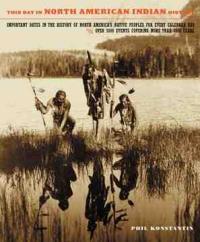 Click on the cover to order a copy or to get more info.
|
This Day in North American Indian History
This Day in North American Indian History is a one-of-a-kind, vastly
entertaining and informative book covering over 5000 years of North American Indian
history, culture, and lore. Wide-ranging, it covers over 4,000 important events
involving the native peoples of North America in a unique day-by-day format.
The thousands of entries in This Day in North American Indian History weave
a compelling and comprehensive mosaic of North American Indian history spanning more
than five millennia-every entry an exciting opening into the fascinating but little-
known history of American Indians.
Over 100 photographs and illustrations - This book has 480 pages, weighs 2.2 pounds and
is 8" by 9.5" in size. The Dates, Names and "Moons" section of these pages are based
on the book. |
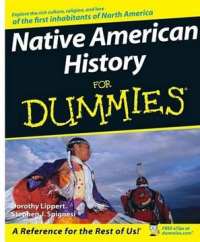
This is the cover to my 4th book. Click here to got more info, or to order a copy or to get more info."
|
Native American History For Dummies
I wrote six of the twenty-four chapters in this book. I am credited with being the technical editor.
Book Description:
Native American History For Dummies introduces readers to the thousand-year-plus
history of the first inhabitants of North America and explains their influence on
the European settlement of the continent. Covering the history and customs of the
scores of tribes that once populated the land, this friendly guide features vivid
studies of the lives of such icons as Pocahontas, Sitting Bull, and Sacagawea;
discusses warfare and famous battles, offering new perspectives from both battle
lines; and includes new archaeological and forensic evidence, as well as oral
histories that show events from the perspective of these indigenous peoples. The
authors worked in concert with Native American authorities, institutions, and
historical experts to provide a wide range of insight and information.
|

This is the cover to my 3rd book. Click here to got more info, or to order a copy or to get more info
|
Treaties With American Indians I wrote an article and several appendix items for this book.
Clips from a review on Amazon.com: *Starred Review* In the 93 years from 1778 until 1871, there were
more than 400 treaties negotiated by Indian agents and government officials.
Editor Fixico and more than 150 contributors have crafted a three volume comprehensive tool that will
soon become essential for anyone interested in the topic.
A resource section with lists of ?Alternate Tribal Names and Spellings,? ?Tribal Name Meanings,?
(<---- I wrote this part) Treaties by Tribe,? and ?Common Treaty Names? and a bibliography and
comprehensive index are repeated in each volume. This
impressive set has a place in any academic library that supports a Native American studies or
American history curriculum. It is the most comprehensive source of information on Canadian-Indian treaties and
U.S.-Indian treaties. Also available as an e-book.
|

"The Wacky World of Laws"
It was just released in May 2009.
|
The Wacky World of Laws. Click on the cover to order a copy or to get more info.
The Wacky World of Laws is a compilation of U.S. and International Laws that are out of the ordinary.
With the U.S. churning out 500,000 new laws every year and 2 million regulations annually, this book
is the ideal go-to book fro everyone who wants a good laugh at the expense of our legal system. Law
so often can be boring! Now with The Wacky World of Laws, you can be the hit of any water cooler
conversation, and amaze your friends with precious legal nuggets.
I wrote most of this book. It is my fifth book.
|
(copyright, © Phil Konstantin, 1996-2013)

Return to Previous Website

since September 4, 2005