Click Here To Return to Previous Website
Click Here To Return to My Main KUSI Page
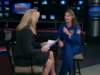
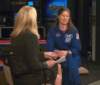
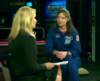
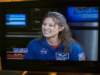
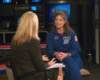
Astronaut Tracy Caldwell
Astronaut Tracy Caldwell visited us on the 40th anniversary of the first moon landing. She holds
the distinction of being the first astronaut to have been born AFTER the first moonlanding. She is intelligent, well spoken and very friendly.
Here is her biography as prepared by NASA:
 Tracy E. Caldwell (Ph.D.)
NASA Astronaut

PERSONAL DATA: Born in Arcadia, California. Enjoys sports, hiking, and auto repair/maintenance.
Competed in intercollegiate Track & Field at CSUF as both a sprinter and long jumper.

EDUCATION: Received B.S. in Chemistry from the California State University at Fullerton (1993)
and Ph.D. in Chemistry from the University of California at Davis (1997).

SPECIAL HONORS: NASA Go the Extra Mile (GEM) Award (2001), NASA Superior Accomplishment
Award (2000), Outstanding Doctoral Student Award in Chemistry from UC Davis (1997), Patricia
Roberts Harris Graduate Fellowship in Chemistry (1993-1997). Lyle Wallace Award for Service to
the Department of Chemistry, CSU Fullerton (1993). National Science Foundation Research Experience
for Undergraduates Award, (1992). Council of Building & Construction Trades Scholarship (1991 & 1992).
Big West Scholar Athlete (1989-1991).

EXPERIENCE: As an undergraduate researcher at CSU Fullerton, Caldwell designed, constructed
and implemented electronics and hardware associated with a laser-ionization, time-of-flight mass
spectrometer for studying atmospherically-relevant gas-phase chemistry. During that time she also
worked as an electrician/inside wireman for her father's electrical contracting company doing
commercial and light industrial type construction. At UC Davis, Caldwell taught general chemistry
laboratory and began her graduate research. Her dissertation work focused on investigating
molecular-level surface reactivity and kinetics of metal surfaces using electron spectroscopy,
laser desorption, and Fourier transform mass spectrometry techniques. She also designed and
built peripheral components for a variable temperature, ultra-high vacuum scanning tunneling
microscopy system. In 1997, she received the Camille and Henry Drefus Postdoctoral Fellowship
in Environmental Science to study atmospheric chemistry at the University of California, Irvine.
There she investigated reactivity and kinetics of atmospherically relevant systems using atmospheric
pressure ionization mass spectrometry, Fourier transform infrared and ultraviolet absorption
spectroscopies. In addition, she developed methods of chemical ionization for spectral interpretation
of trace compounds. Dr. Caldwell has published and presented her work in numerous papers at
technical conferences and in scientific journals. She is a private pilot and conversational in American
Sign Language ( ASL) and Russian.

NASA EXPERIENCE: Selected by NASA in June 1998, Caldwell reported for training in August 1998.
In 1999, she was first assigned to the Astronaut Office ISS Operations Branch as a Russian Crusader,
participating in the testing and integration of Russian hardware and software products developed for
ISS. In 2000, she was assigned prime Crew Support Astronaut for the 5 th ISS Expedition crew,
serving as their representative on technical and operational issues throughout the training and
on-orbit phase of their mission. Caldwell has worked inside Mission Control as spacecraft communicator
(CAPCOM) for both Space Shuttle and ISS operations, serving also as the lead CAPCOM for ISS
Increment 11. Other technical assignments have included flight software verification in the Shuttle
Avionics Integration Laboratory (SAIL) and supporting Shuttle launch and landing operations at
Kennedy Space Center, Florida. She has logged over 305 hours in space having completed her first
space flight on STS-118 in 2007.

SPACE FLIGHT EXPERIENCE: STS-118 (August 8-21, 2007) was the 119th space shuttle flight, the
22nd flight to the International Space Station (ISS), and the 20th flight for Endeavour. During the
mission Endeavour's crew successfully added truss segment S5 and a new gyroscope to the ISS.
As MS-1, Caldwell assisted in flight deck operations on ascent and also aided in rendezvous/docking
operations with the ISS. Caldwell operated Endeavour's robotic arm to maneuver the Orbiter Boom
Sensor System (OBSS) and handover the S5 truss segment to the ISS, and also served as the
intravehicular or "IV" crewmember, directing the four spacewalks. Traveling 5.3 million miles in space,
the STS-118 mission was completed in 12 days, 17 hours, 55 minutes and 34 seconds.

JUNE 2008
Click on any of these small pictures to see a larger version of it.






Tracy E. Caldwell (Ph.D.) NASA Astronaut PERSONAL DATA: Born in Arcadia, California. Enjoys sports, hiking, and auto repair/maintenance. Competed in intercollegiate Track & Field at CSUF as both a sprinter and long jumper. EDUCATION: Received B.S. in Chemistry from the California State University at Fullerton (1993) and Ph.D. in Chemistry from the University of California at Davis (1997). SPECIAL HONORS: NASA Go the Extra Mile (GEM) Award (2001), NASA Superior Accomplishment Award (2000), Outstanding Doctoral Student Award in Chemistry from UC Davis (1997), Patricia Roberts Harris Graduate Fellowship in Chemistry (1993-1997). Lyle Wallace Award for Service to the Department of Chemistry, CSU Fullerton (1993). National Science Foundation Research Experience for Undergraduates Award, (1992). Council of Building & Construction Trades Scholarship (1991 & 1992). Big West Scholar Athlete (1989-1991). EXPERIENCE: As an undergraduate researcher at CSU Fullerton, Caldwell designed, constructed and implemented electronics and hardware associated with a laser-ionization, time-of-flight mass spectrometer for studying atmospherically-relevant gas-phase chemistry. During that time she also worked as an electrician/inside wireman for her father's electrical contracting company doing commercial and light industrial type construction. At UC Davis, Caldwell taught general chemistry laboratory and began her graduate research. Her dissertation work focused on investigating molecular-level surface reactivity and kinetics of metal surfaces using electron spectroscopy, laser desorption, and Fourier transform mass spectrometry techniques. She also designed and built peripheral components for a variable temperature, ultra-high vacuum scanning tunneling microscopy system. In 1997, she received the Camille and Henry Drefus Postdoctoral Fellowship in Environmental Science to study atmospheric chemistry at the University of California, Irvine. There she investigated reactivity and kinetics of atmospherically relevant systems using atmospheric pressure ionization mass spectrometry, Fourier transform infrared and ultraviolet absorption spectroscopies. In addition, she developed methods of chemical ionization for spectral interpretation of trace compounds. Dr. Caldwell has published and presented her work in numerous papers at technical conferences and in scientific journals. She is a private pilot and conversational in American Sign Language ( ASL) and Russian. NASA EXPERIENCE: Selected by NASA in June 1998, Caldwell reported for training in August 1998. In 1999, she was first assigned to the Astronaut Office ISS Operations Branch as a Russian Crusader, participating in the testing and integration of Russian hardware and software products developed for ISS. In 2000, she was assigned prime Crew Support Astronaut for the 5 th ISS Expedition crew, serving as their representative on technical and operational issues throughout the training and on-orbit phase of their mission. Caldwell has worked inside Mission Control as spacecraft communicator (CAPCOM) for both Space Shuttle and ISS operations, serving also as the lead CAPCOM for ISS Increment 11. Other technical assignments have included flight software verification in the Shuttle Avionics Integration Laboratory (SAIL) and supporting Shuttle launch and landing operations at Kennedy Space Center, Florida. She has logged over 305 hours in space having completed her first space flight on STS-118 in 2007. SPACE FLIGHT EXPERIENCE: STS-118 (August 8-21, 2007) was the 119th space shuttle flight, the 22nd flight to the International Space Station (ISS), and the 20th flight for Endeavour. During the mission Endeavour's crew successfully added truss segment S5 and a new gyroscope to the ISS. As MS-1, Caldwell assisted in flight deck operations on ascent and also aided in rendezvous/docking operations with the ISS. Caldwell operated Endeavour's robotic arm to maneuver the Orbiter Boom Sensor System (OBSS) and handover the S5 truss segment to the ISS, and also served as the intravehicular or "IV" crewmember, directing the four spacewalks. Traveling 5.3 million miles in space, the STS-118 mission was completed in 12 days, 17 hours, 55 minutes and 34 seconds. JUNE 2008
Click on any of these small pictures to see a larger version of it.
|
|
|
|
|
|
|
|
|
|
|
|
|
|
|
|
|
|
|
|
|
|
|
|
|
|
|
|
|
|
|
Photo album created with Web Album Generator
Return to Previous Website
Click Here To Return to My Main KUSI Page
since September 4, 2005