| << Previous | Index | Next >> | ||
 |
 |
 |
 |
 |
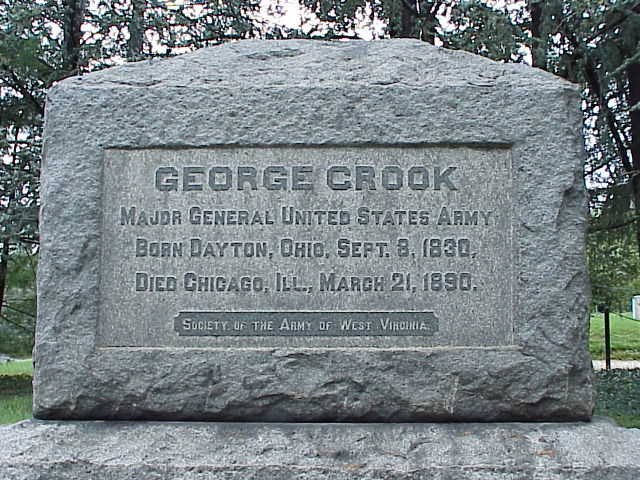
Maj. Gen. George Crook, USA = (September 8, 1828 – March 21, 1890) Crook was a career United States Army officer, most noted for his distinguished service during the American Civil War and the Indian Wars. At the end of the Civil War, George Crook received a brevet as major general in the regular army, but reverted to the permanent rank of lieutenant colonel, serving with the 23rd Infantry on frontier duty in the Pacific Northwest. He successfully campaigned against the Snake Indians in the Snake War where he won the recognition of President Ulysses S. Grant. Grant placed Crook in command of the Arizona Territory. Crook's use of Apache scouts brought him much success in forcing the Apache Indians, under chief Cochise onto reservations. In 1872 the Arizona Territory was at peace and Crook was appointed brigadier general in the regular army, a promotion that passed over and angered several full colonels next in line for promotion to general. He next served against the Sioux during the Great Sioux War of 1876-77. He fought the Lakota at the Battle of the Rosebud. On 28 May 1876, Brigadier General George Crook assumed direct command of the Bighorn and Yellowstone Expedition at Fort Fetterman. Crook had drawn together an impressive force from his Department of the Platte. Leaving Fort Fetterman on 29 May, the 1,051-man column consisted of 15 companies from the 2d and 3d Cavalry, 5 companies from the 4th and 9th Infantry, 250 mules, and 106 wagons. On 14 June, the column was joined by 261 Shoshone and Crow allies. Based on intelligence reports, Crook ordered his entire force to lighten itself for a quick march. Each man was to carry only 1 blanket, 100 rounds of ammunition, and 4 days' rations. The wagon train would be left at Goose Creek, and the infantry would be mounted on the pack mules. On 17 June, Crook's column roused itself at 0300 and set out at 0600, marching northward along the south fork of Rosebud Creek. The holiday atmosphere that prevailed since the arrival of the Indian scouts was suddenly absent. The Crow and Shoshone scouts were particularly apprehensive. Although the column had not yet encountered any sign of Indians, the scouts seemed to sense their presence. For their part, the soldiers, particularly the mule-riding infantry, were apparently fatigued from their early morning reville and the previous day's 35-mile march. Accordingly, Crook stopped to rest his men and animals at 0800. Although he was deep in hostile territory, Crook made no special dispositions for defense. His troops merely halted in their marching order. The Cavalry battalions led the column followed by the battalion of mule-borne foot soldiers,and a provisional company of civilian miners and packers brought up the rear. Fortunately the Crow and Shoshone scouts remained alert while the soldiers rested. Several minutes later, the soldiers in camp could hear the sound of intermittent gunfire coming from the bluffs to the north. At first, they dismissed the noise as nothing more than the scouts taking potshots at buffalo. As the intensity of fire increased, a scout rushed into the camp shouting, "Lakota, Lakota!" The Battle of the Rosebud was on. By 0830, the Sioux and Cheyenne had hotly engaged Crook's Indian allies on the high ground north of the main body. Heavily outnumbered, the Crow and Shoshone scouts fell back toward the camp, but their fighting withdrawal gave Crook time to deploy his forces. The attackers were driven off by rapid firing soldiers which used up much of the ammunition meant for use later in the campaign. Low on ammo and with a considerable number of wounded, the General returned to his post. Whether Crook's pressing on instead could have prevented the subsequent slaughter of five companies of the 7th Cavalry Regiment led by George Armstrong Custer at the Battle of the Little Bighorn is debatable. He was the Commander of the Department of the Platte from 1875 to 1882, with headquarters at Fort Omaha in North Omaha, Nebraska. During this period, in 1879, he spoke on behalf of the Ponca tribe and Native American rights during the trial of Standing Bear v. Crook. That same year his home, now called the General Crook House, was completed. By 1882, Crook was back in command in Arizona. The Apaches had once again taken up arms against the U.S. army under the leadership of Geronimo. Crook repeatedly forced the surrender of the Apaches but saw Geronimo escape. The Apache, as a mark of respect, nicknamed Crook Nantan Lupan, which means "Grey Wolf". Nelson A. Miles replaced Crook in command of the Arizona Territory and brought an end to the Apache Wars when he sent Geronimo, the Chiricahua Apache tribe and the Chiricahua scouts serving in the U.S. Army into exile in Florida. (Crook was reportedly furious and appalled that the scouts, who had faithfully served the Army against their own tribe, were sent as well and telegrammed numerous protests to Washington. They, along with most of Geronimos band, were forced to spend the next 26 years in captivity before they were finally released.) After years of campaigning in the Indian Wars, Crook won steady promotion back up the ranks to the permanent grade of Major General, and President Grover Cleveland placed him in command of the "Military Division of the Missouri" in 1888. Crook served in Omaha again as the Commander of the Department of the Platte from 1886 to 1888. While he was there, his portrait was painted by artist Herbert A. Collins. He spent his last years speaking out against the unjust treatment of his former Indian adversaries. He died suddenly in Chicago while serving as commander of the Division of the Missouri. Crook was originally buried in Oakland, Maryland, but was moved to Section 2 of Arlington National Cemetery on November 11, 1898. Red Cloud, a war leader of the Oglala Lakota (Sioux), said of Crook when he died, "He, at least, never lied to us. His words gave us hope."
Photo album created with Web Album Generator