| << Previous | Index | Next >> | ||
 |
 |
 |
 |
 |
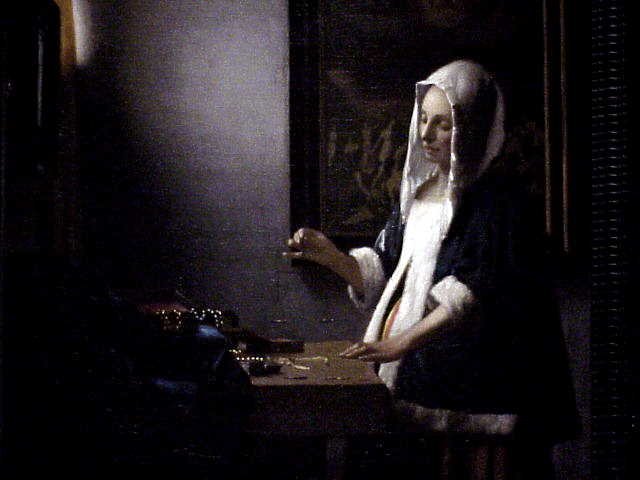
Johannes Vermeer, Woman Holding a Balance, c. 1664, National Gallery of Art, Widener Collection - Light flows from a window, accentuating a hand, a sleeve, a face. It washes across the wall, revealing a painting of the Last Judgment. It shimmers across gold and pearl jewelry. In the center hangs a balance, empty but for the light itself. Dressed in a blue fur-trimmed jacket, a woman stands alone before a table in the corner of a room. She holds the balance in her right hand and with lowered eyes waits for it to come to rest. A blue cloth, some open boxes, two strands of pearls, and a gold chain lie on the table. While the woman seems psychologically removed from us, her graceful figure and serene face suggest an inner peace. She is oblivious to our presence. Her pensive stillness suggests she may be weighing something more profound than jewelry. In waiting for the balance to rest at equilibrium, she acknowledges the importance of judgment in assessing her own actions. Woman Holding a Balance captures that brief moment when a familiar action is lifted to the eternal. The poetry of Vermeer's paintings is immediate and recognizable. In Vermeer's hands, the stillness of the scene, the woman's concentration on her task, and the soft light that gently illuminates the room become at once heightened and familiar. Through his sensitivity to light, color, and composition, Vermeer transforms seemingly ordinary subjects into expressions of perfect balance and harmony. Woman Holding a Balance embodies a spiritual principle that is often manifest in Vermeer's work: the need to lead a balanced life. Though Vermeer's working methods remain a mystery, it is clear that he constructed this composition with extreme care. Orthogonal lines to the vanishing point meet precisely at the woman's finger. The frame behind her reinforces this focus. The balance point of the scales is exactly at the center of the painting. The woman's hands, the jewelry, and the tabletop form the shape of a pyramid. This imaginary pyramid supports the woman's hand and encloses the balance. Vermeer frequently modified the scale and even the shape of objects to achieve a desired effect. Note, for example, that the bottom edge of the frame around the Last Judgment scene is higher in front of the woman than behind her, to allow sufficient space for the balance. The interplay of verticals and horizontals, of mass against void, and of light against dark creates a carefully balanced, but never static, composition. This underlying pictorial structure subtly reinforces the theme of spiritual moderation. In 1994 conservators at the National Gallery cleaned the painting, removing discolored varnish from its surface. Their work revealed that at some point in the past, the painting had been extended by a half inch on all four sides. To restore it to its original size, conservators removed the added paint. Also in the past, black and grayish paint had been added, particularly on the frame of The Last Judgment. After three month's work, golden yellow highlights that originally represented the frame's gilding were uncovered. Compare photographs of the work before and after treatment. The conservators completed their work by replacing the existing frame with one from the same period as the painting. Vermeer's Woman with a Balance contains multiple levels of meaning. Much of its significance depends upon the emotions and experiences of the viewer. Touch the buttons to learn about various aspects of the painting's symbolism.
Photo album created with Web Album Generator